
Quick Answer
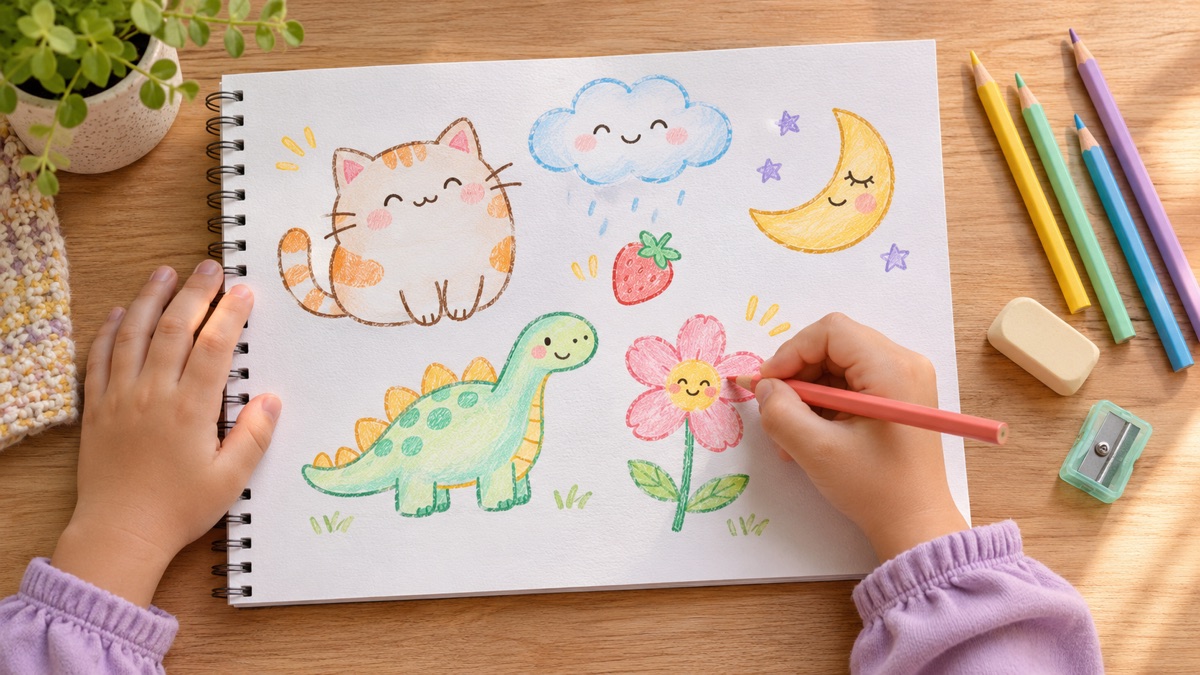
The easiest cute drawing ideas for kids begin with familiar shapes and one or two expressive details. Draw a circle, oval, triangle, or rounded rectangle; turn it into an animal, snack, plant, or weather character; then add dot eyes, a tiny mouth, and one personal detail. A smiling cloud, sleepy moon, round cat, toast character, strawberry, turtle, and baby dinosaur are all good first choices.
Keep the first drawing small enough to finish in about 10 minutes. Light construction lines make changes easy, while a dark final outline and two or three colors help the character read clearly. The goal is not to copy a perfect sample. It is to learn a reusable shape recipe, make a few choices, and leave the page wanting to draw again.
How to Draw offers kid-friendly references and guided lessons for iPhone and iPad, ready for a quick paper drawing session.
What Makes a Drawing Look Cute?
Cute drawings usually simplify a subject rather than adding lots of detail. The head may be a little larger than expected, the body may be short and rounded, and sharp corners may become soft curves. Facial features sit close together, often low on the face, with generous open space around them. These are design choices, not strict rules. Children can change any of them and still create a delightful character.
A simple drawing becomes memorable when it has one clear emotion or action. Tilt the eyes into happy arcs, add a tiny yawn, give the character a leaf umbrella, or place a favorite snack beside it. Instead of asking whether the drawing is “right,” ask what the character is feeling, where it is going, or what name it should have. Those questions turn a doodle into a story.
The National Gallery of Art describes shape as a flat area surrounded by edges or an outline and distinguishes regular geometric shapes from the more flowing shapes found in nature. That is a useful way to look at cute characters: start with recognizable circles, ovals, squares, and triangles, then soften, stretch, overlap, and decorate them until they feel alive.
Simple Supplies That Keep Art Time Easy
- Plain paper or a sketchbook: inexpensive paper makes experimentation feel low pressure.
- HB pencil: it is dark enough to see but easy to erase when used lightly.
- Soft eraser: use it to lift construction marks, not to chase every wobble.
- Black fineliner or dark colored pencil: optional for a clean final outline.
- Crayons, washable markers, or colored pencils: choose the material the child can control comfortably.
- A reference: use a real object, a photo, or a friendly lesson from How to Draw.
Put out a limited selection rather than every supply at once. A pencil, eraser, and six colors are enough. Fewer choices reduce setup and cleanup, and children can focus on the drawing instead of sorting materials. Cover the table when using markers, keep sharpeners within reach, and choose washable materials for younger artists.
24 Cute Drawing Ideas for Kids
Choose one idea or roll a die to select a group. Each prompt includes a simple starting shape and one optional detail. Children can combine two prompts—such as a cloud holding a strawberry—to invent something new.
- 1. Round cat Start with a wide circle, add triangle ears, a curled tail, and three whiskers on each side.
- 2. Puppy face Use a circle with two floppy oval ears, a dark nose, and a tongue peeking out.
- 3. Baby bunny Stack a circle over an oval, then add long ears, tiny paws, and soft cheek color.
- 4. Sleepy fox Turn a rounded triangle into a head, close the eyes, and wrap the tail around the body.
- 5. Tiny turtle Draw a half-circle shell, a small oval head, four short legs, and a repeating shell pattern.
- 6. Baby dinosaur Build a curved bean-shaped body, a long neck, little feet, and rounded back plates.
- 7. Happy strawberry Use a heart-like berry shape, add a leafy cap, seed dots, and a cheerful face.
- 8. Toast character Round the corners of a square, add a wavy crust line, and give it jam-red cheeks.
- 9. Cupcake friend Stack a frosting cloud on a striped wrapper and finish with a cherry or star.
- 10. Orange slice Draw a half-circle, divide it into sections, and add two small feet underneath.
- 11. Boba cup Make a tall rounded rectangle with dark pearl circles, a wide straw, and a simple face.
- 12. Ice cream cone Place a round scoop over a triangle, add a waffle pattern, and let one drip curve down.
- 13. Smiling cloud Join several soft bumps, add two raindrops, and draw a small rainbow nearby.
- 14. Sleepy moon Draw a crescent, close one eye, add a blush circle, and surround it with three stars.
- 15. Sun with sunglasses Put short rays around a circle and add bold glasses with a curved smile.
- 16. Little planet Draw a circle and tilted ring, then add craters, stars, and a tiny waving flag.
- 17. Flower face Place rounded petals around a circle and add two leaves shaped like stretched hearts.
- 18. Cactus buddy Use a tall oval with two short arms, a pot, tiny dot spines, and a flower on top.
- 19. Mushroom house Put a wide cap over a short stem, then add a round door and pebble path.
- 20. Leaf character Draw a pointed oval with a center vein, stick arms, boots, and a windblown expression.
- 21. Pencil pal Make a long rectangle with a triangle tip, banded eraser, face, and waving arm.
- 22. Friendly backpack Round a tall rectangle, add a front pocket, straps, and a keychain charm.
- 23. Book character Draw a slightly open rectangle with curved pages, glasses, and a bookmark tongue.
- 24. Mini robot Stack a square head over a rounded rectangle body and add antennae and button shapes.
The Easy Shape Recipe
- Pick one large shape. Use a circle, oval, triangle, square, or bean shape for the head or body. Draw with two or three light passes instead of trying to make one perfect line.
- Add one overlapping shape. Attach a smaller oval for a body, a half-circle for a shell, or two triangles for ears. Overlap is useful because the hidden lines can be erased later.
- Place the face. Mark two dot eyes on the same imaginary line. Put the mouth a short distance below them. Keep the features small at first; they are easier to enlarge than to move.
- Add the identifying parts. A cat needs ears and whiskers, a strawberry needs leaves and seeds, and a planet needs a ring. Choose only the details that make the subject recognizable.
- Choose one personality detail. Try a hat, bow, backpack, sleepy expression, favorite snack, or tiny companion. One strong idea is clearer than many unrelated decorations.
- Clean and color. Darken the lines you want to keep, erase distracting construction marks, and color lightly before adding darker accents and shadows.
This same process works for nearly every prompt above. Children who want more structure can follow the step-by-step drawing practice guide. Families who want a little extra support can also explore phone-guided AR drawing practice before making a freehand version.
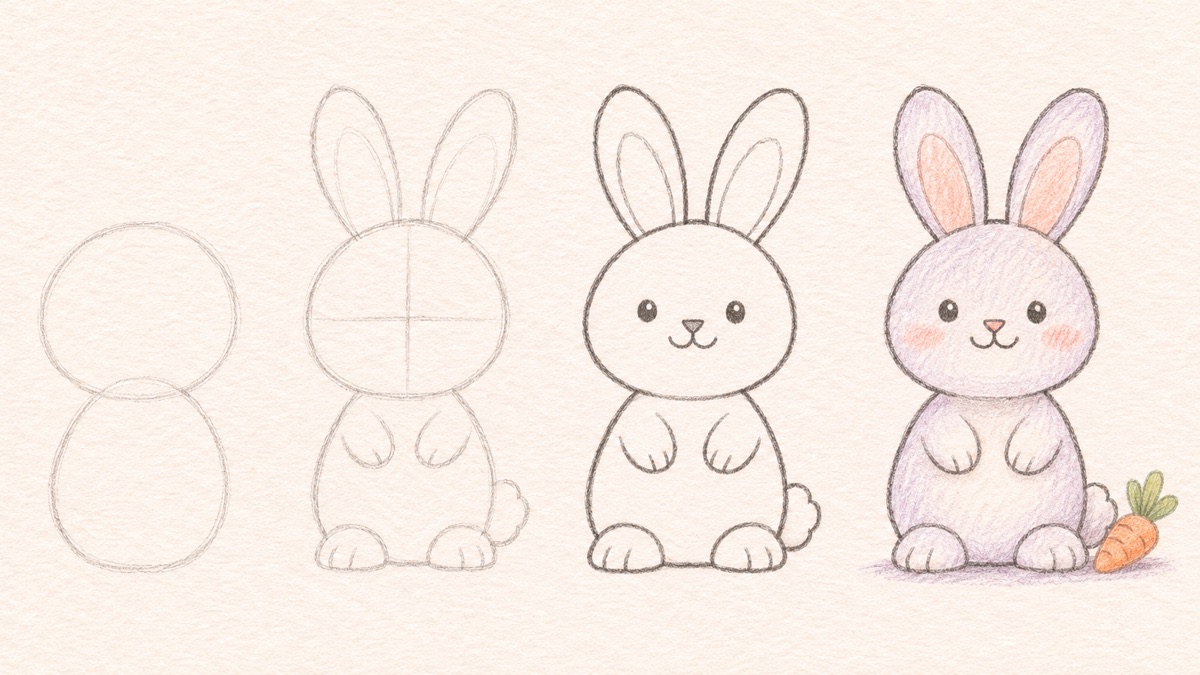
Cute Bunny Drawing: 8 Easy Steps
- Draw the head. Make a large circle in the upper middle of the page. Leave space above for ears and below for the body.
- Add the body. Place a slightly smaller vertical oval under the head. Let the shapes overlap so the bunny feels connected.
- Build the ears. Add two tall rounded ovals above the head. They can lean apart, stand straight, or bend at the tips.
- Place paws and feet. Draw two short ovals near the top of the body for front paws and two wider ovals at the bottom for feet.
- Mark the face. Put two dot eyes below the center of the head. Add a tiny upside-down triangle nose and two short curves for the mouth.
- Add bunny details. Draw smaller shapes inside the ears, two or three toe marks, and a fluffy half-circle tail on one side.
- Clean the outline. Darken the outside contour and erase the line where the head overlaps the body. Keep a little hand-drawn wobble; it adds warmth.
- Color and finish. Add a light color layer, pink or peach inside the ears, soft cheek circles, and a small ground shadow. A carrot, flower, or name tag can complete the story.
If animals are the favorite subject, the detailed animal drawing guide for kids shows how the same shapes can become cats, dogs, fish, turtles, and owls.
How to Adapt the Ideas by Age
Ages 4–6: one shape and one choice
Offer large paper, thick crayons or washable markers, and one prompt at a time. A grown-up can draw the first circle or fold the page into roomy boxes. Let the child choose the face, colors, and story. If a line misses its target, turn it into fur, a shadow, a patch, or a new character instead of immediately erasing it.
Ages 7–9: combine shapes and expressions
Ask the child to build the character from two or three shapes and try three thumbnail expressions before choosing one. Encourage simple overlaps: a paw holding a berry, a cloud in front of a moon, or a backpack behind a robot. This is a good age to add a clean outline after the sketch.
Ages 10–12: create a character set
Use one shape recipe to design three related characters. Keep the eye style, line weight, and color palette consistent while changing proportions and accessories. Children can turn the set into stickers, a comic strip, a bookmark, or a greeting card. The extra purpose makes repetition feel like design rather than a drill.
How Grown-Ups Can Encourage Without Taking Over
Specific observations are more useful than a quick “good job.” Try, “I noticed you used three kinds of circles,” “That tiny umbrella tells me a story,” or “Your darker outline makes the character easy to see.” These comments show attention without deciding what the art should become.
NAEYC recommends process-focused art experiences that give children choices, time, varied materials, and room to explore. A step-by-step lesson can still support that spirit when it is treated as a starting scaffold rather than a required final product. Demonstrate a shape or tool, then invite the child to change the colors, expression, setting, or subject.
Avoid redrawing directly on the child’s work unless asked. If they want help, demonstrate on a separate scrap of paper or talk through the next small action. When frustration appears, shrink the task: draw only the face, trace the circle around a cup, or finish one character today and the background tomorrow. The confidence-building drawing guide has more ways to make practice feel achievable.
A 15-Minute Cute Drawing Routine
- Minutes 1–2: fill a scrap area with circles, ovals, curves, dots, and tiny faces.
- Minutes 3–4: choose one prompt and sketch its largest shapes very lightly.
- Minutes 5–8: add the face, identifying parts, and one personality detail.
- Minutes 9–11: select the clean outline and erase only the marks that distract.
- Minutes 12–14: add two or three colors, a small shadow, and one background clue.
- Minute 15: give the character a name and circle one part to try differently next time.
Stop while the session still feels successful. A short, finished drawing often builds more momentum than a long page that ends in exhaustion. On the next day, redraw the same character from memory or choose a related prompt. For more variety, mix this routine with the at-home drawing games or the easy flower lesson.
Related Drawing Guides
- How to Draw: Lessons, References, and Paper Practice
- How to Draw for Kids: Easy Ideas That Build Confidence
- How to Draw Animals for Kids
- Fun Drawing Games for Kids at Home
- How to Draw Step by Step Practice Guide
- AR Drawing Practice With Phone-Guided References
References
- NAEYC: How Process-Focused Art Experiences Support Preschoolers
- NAEYC: Using Process Art to Spark Preschoolers’ Development
- National Gallery of Art: The Elements of Art—Shape
- National Gallery of Art: Explore the Basics of Drawing
- National Gallery of Art: Sketchbook Club for Families
Open How to Draw for kid-friendly references and guided lessons, then add your own expressions, accessories, and stories on paper.