
Quick Start: Pick One Game and Set a Timer
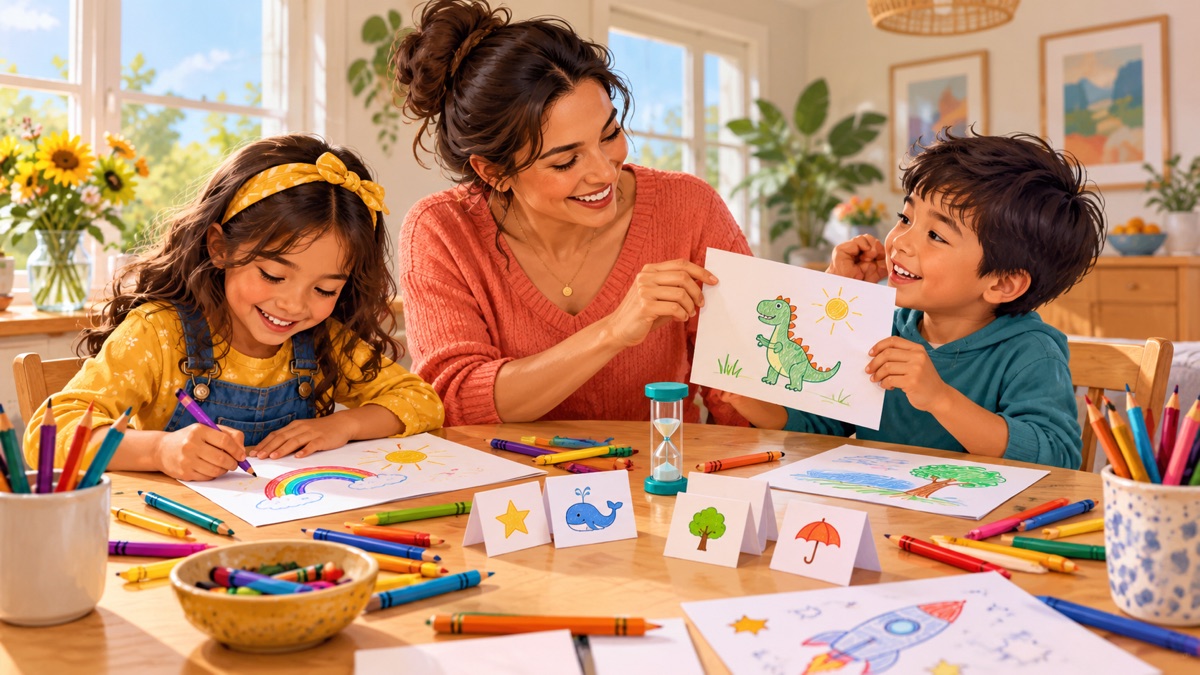
You do not need a craft room or expensive supplies to make drawing feel like play. Put plain paper, pencils, crayons, or washable markers on a table. Choose one game from the list below, explain the rule in a single sentence, and play for 10 to 15 minutes. The goal is not to make the “best” picture. It is to notice, imagine, take turns, and make enough marks that the blank page stops feeling intimidating.
Drawing games work especially well when adults participate without correcting every line. Let the child make the surprising choice. Ask what is happening in the picture, copy one of their ideas, and treat unusual proportions as part of the story. The American Academy of Pediatrics notes that shared art projects can support flexibility and collaborative thinking, while the simple act of creating together can make indoor family time more connected.
Open How to Draw for kid-friendly subjects, guided lessons, sketch references, and paper practice on iPhone or iPad.
A No-Stress Setup for Family Drawing Games
Cover the table if you are using markers, then give each player several sheets of inexpensive paper. Ordinary printer paper is ideal because nobody feels pressure to protect a “special” page. Keep an eraser available, but consider starting with crayons or pens for games where speed and imagination matter more than revision. Place finished pages in one pile so the group can look back at the collection at the end.
- For ages 3–5: use large paper, thick crayons, simple shapes, and rounds of five minutes or less.
- For ages 6–8: add prompt cards, short timers, silly combinations, and turn-taking rules.
- For ages 9–12: try memory challenges, comics, visual storytelling, and more detailed constraints.
- For mixed ages: give younger players fewer rules and let older players add backgrounds, labels, or story details.
Keep the challenge slightly above the child’s comfort level, but change it if frustration replaces curiosity. Harvard’s Center on the Developing Child recommends matching games to children’s skill levels and gradually increasing complexity. That can be as simple as using one shape in the first round, two shapes in the next, and a short story prompt in the third.
Drawing Games That Build Imagination
1. Finish the picture
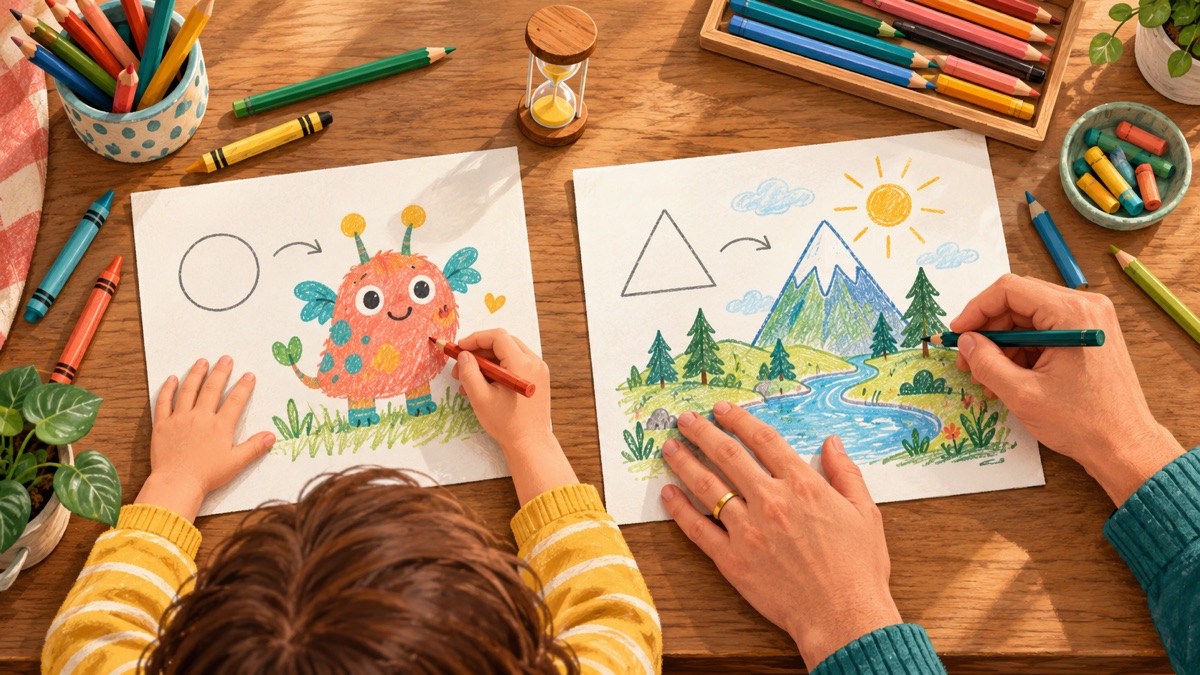
One person draws a starter shape—a circle, zigzag, triangle, spiral, or pair of dots—and passes the page to another player. The second player turns it into anything they imagine. A circle might become a planet, an eye, a pizza, or the body of a tiny monster. Ask each artist to explain one choice after the reveal. For a harder version, use the same starter shape on every page and compare how differently the family interpreted it.
2. Three-shape creature
Choose three shapes, such as an oval, rectangle, and star. Every player must use all three to invent a creature. Shapes may become a body, ears, feet, patterns, or an object the creature carries. Add a habitat and one favorite food if children want to continue. This game quietly encourages flexible thinking because the same limited ingredients can lead to many valid results.
3. Silly prompt pairs
Make two small stacks of cards. Put characters in one stack—cat, robot, dragon, grandparent, astronaut—and actions or places in the other—baking a cake, under the ocean, at the library, riding a scooter. Draw one card from each pile and illustrate the combination. Children who say they do not know what to draw usually need a smaller decision, not a bigger list of possibilities.
4. Pass-the-picture
Each player starts a drawing for one minute, then passes it to the left. The next person adds something without covering the earlier work. Continue until every page returns to its first artist. Before starting, agree that additions should be kind and should help the picture grow. The AAP suggests a similar turn-taking drawing activity for siblings because collaboration gives children a reason to respond to one another’s ideas.
Drawing Games That Train Careful Looking
5. Look, hide, and draw
Place a familiar object on the table: a toy car, spoon, leaf, sneaker, or stuffed animal. Everyone studies it for 30 seconds. Hide the object and draw it from memory for two minutes. Bring it back and circle three details you remembered, then add one detail you missed in a different color. This keeps the comparison constructive; players are collecting observations, not scoring accuracy.
6. Texture hunt
Find five safe household textures, such as a woven basket, smooth mug, fuzzy towel, wooden table, and wrinkled paper bag. Make a small drawing swatch for each using dots, dashes, loops, crosshatching, or wavy lines. Then invent an animal or place that uses at least three of the textures. The activity connects close observation with imaginative reuse.
7. Blind contour challenge
Choose a hand, shoe, plant, or simple toy. Draw its outline slowly without looking down at the paper. Keep the pencil touching the page until the timer ends. The result will probably be wobbly and surprising—that is the point. Laugh with the drawing, not at the artist. Try again while looking back and forth between subject and page, and notice which shapes become easier to place.
8. Drawing scavenger hunt
Call out visual clues instead of object names: “find something with a circle,” “find two objects that overlap,” “find something taller than your hand,” or “find an interesting shadow.” Children bring back a quick sketch rather than the object. On a nice day, take the hunt outside and look for leaf edges, cloud shapes, bark patterns, or long shadows. The National Gallery of Art’s family sketching programs use simple materials and focused prompts to help children explore works through drawing; the same prompt-based approach translates easily to a room, yard, or neighborhood walk.
Drawing Games for Stories and Laughter
9. Drawing telephone
The first player writes a short, drawable sentence at the top of a page, such as “a penguin plays guitar on the moon,” then folds the sentence behind the paper. The next player draws the sentence and folds again, leaving only the picture visible. The third player writes what they think the picture means. Alternate writing and drawing until the page is full, then unfold it and read the changes from beginning to end. For younger children, an adult can quietly write the sentences they dictate.
10. Four-box family comic
Fold a page into four boxes. In box one, introduce a character. In box two, give the character a small problem. In box three, show an attempt to solve it. In box four, draw the result. Keep speech bubbles optional; expressions, poses, and props can carry the story. If someone gets stuck, ask, “What changes next?” rather than supplying the whole plot.
11. Same scene, new mood
Draw one simple place—a bedroom, park, bus stop, or treehouse—then redraw it with a different mood. Change the weather, colors, line weight, character poses, and size of objects. A calm park might use open space and soft curves; an exciting park might have diagonal lines, flags, and figures in motion. There is no need to teach formal color theory for this game. Ask children which visual change made the biggest difference and why.
12. One-line team adventure
One player starts a continuous line and draws for five seconds without lifting the pencil. The next player continues from the endpoint. After several turns, rotate the page and decide together what the wandering line could become. Add only enough details to reveal the scene. This is a useful final game because it lowers the stakes: no one controls the whole picture, and every mark becomes material for the team.
What to Do When a Child Says “I Can’t Draw”
First, shrink the task. Ask for one circle, one line, or one five-second addition to a shared page. Offer two choices instead of an open question: “Would you rather draw the monster’s feet or its snack?” You can also make the first imperfect mark yourself. An adult who draws a crooked cat and keeps going shows that participation matters more than polish.
Avoid finishing the child’s picture for them. If they ask for help, demonstrate the difficult part on your own paper or break it into shapes. For structured support, the step-by-step drawing practice guide explains how to move from a reference to an independent redraw. Families can also browse the beginner drawing hub or the doodle drawing ideas page for approachable subjects.
Stop while the activity is still enjoyable. Ten focused minutes can build a better family routine than an hour that ends in conflict. Save the drawings in a folder, write the date on the back, and replay a favorite game a few weeks later. The comparison gives children visible evidence that ideas and control can change with practice.
A Simple One-Week Drawing Game Plan
- Monday: finish three starter shapes in 10 minutes.
- Tuesday: study one toy, hide it, and draw from memory.
- Wednesday: make silly prompt pairs and choose one scene.
- Thursday: take turns on a pass-the-picture drawing.
- Friday: create a four-box comic about the week.
- Weekend: take a drawing scavenger hunt or replay the family favorite.
If your family wants a more guided subject between games, start with easy drawing ideas that build confidence or use circles and ovals in the step-by-step animal drawing guide. The photo-to-sketch guide is useful for older children who want to turn a family photo or favorite object into a simpler reference.
Related Drawing Guides
- How to Draw: Lessons, References, and Paper Practice
- How to Draw for Kids: Easy Ideas That Build Confidence
- How to Draw Animals for Kids: Easy Step-by-Step Practice
- AR Drawing App: Trace Pictures on Paper With Your Phone
- How to Draw Step by Step Practice Guide
- Easy Doodle Drawing Ideas
References
- HealthyChildren.org: Indoor Play Ideas—Fun Ways for Families to Connect
- HealthyChildren.org: Siblings as Playmates—5 Ways to Help Prevent Squabbles
- Center on the Developing Child at Harvard University: Brain-Building Through Play
- National Gallery of Art: Sketchbook Club
Download How to Draw, choose one friendly prompt, and make a page together in just 10 minutes.